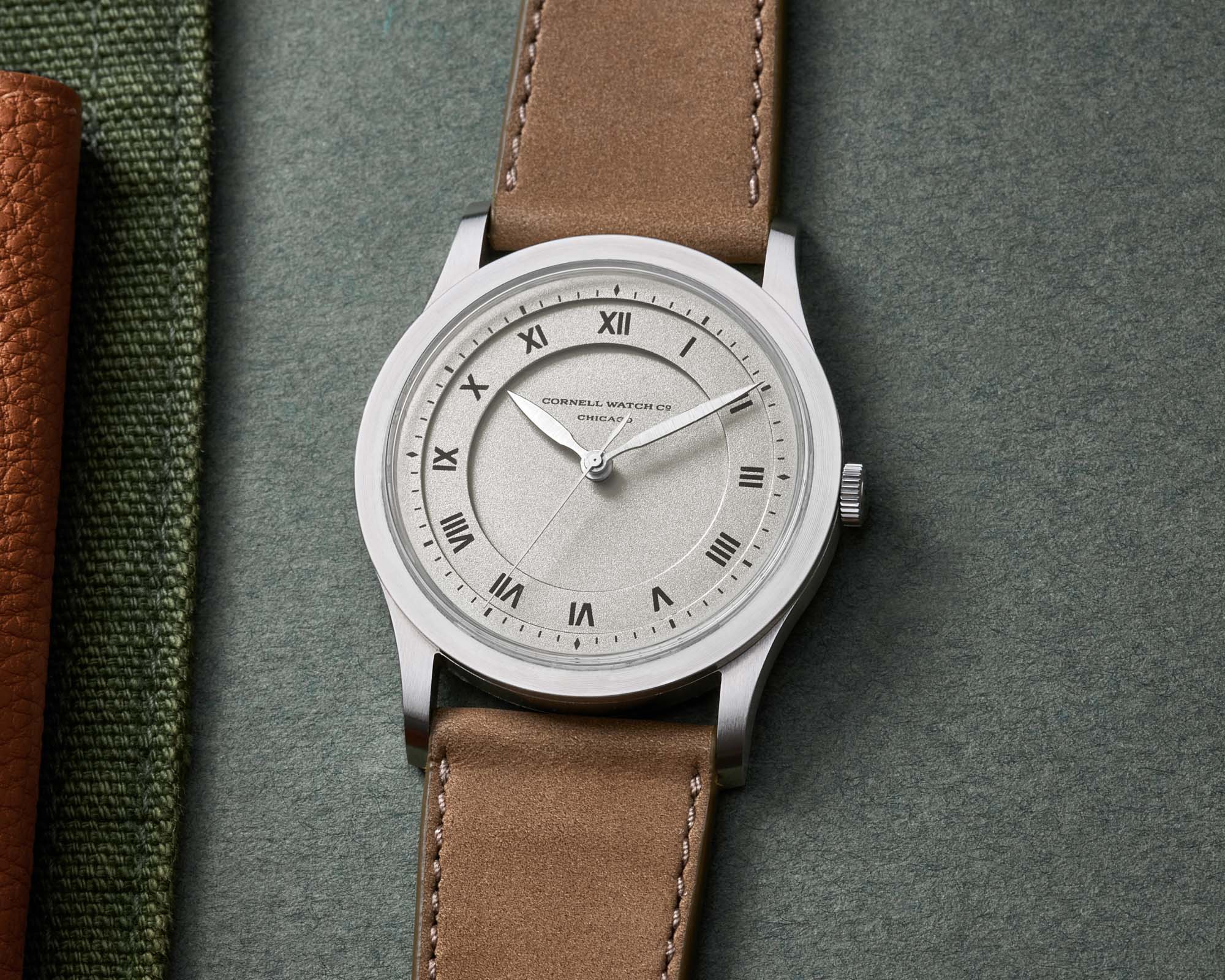
As an American watch enthusiast, I appreciate any effort to revive watchmaking in the United States. However, watches have not been manufactured in America at any considerable scale for more than half a century, and the U.S. no longer has the supply chain or specialists required to mass-produce timepieces entirely on domestic soil. With that in mind, following its revival in 2023, Cornell Watch Company has joined the small list of brands that are committed to restoring American watchmaking, and it has just unveiled a classically styled dress watch called the Lozier as its first permanent-collection model. Aside from its crystal and movement, the rest of the watch’s major components are manufactured right here in the United States, yet Cornell is still able to offer the Lozier for a mid-four-figure price.
The Cornell Watch Company was originally founded in 1870 by Paul Cornell and John C. Adams, and it specialized in high-precision railroad pocket watches that it manufactured at its factory and headquarters in Chicago, Illinois. Similar to many other American watch brands, Cornell more or less ceased to exist by the early 20th century; however, the company was revived in 2023 by John and Chrissy Warren, who are both Chicago natives and passionate collectors of vintage Cornell pocket watches. As genuine fans of the original Cornell brand, the husband/wife duo felt that it would be disingenuous to revive a historic American company but entirely produce its watches elsewhere in the world, and the modern Cornell brand aims to manufacture as much of its components inside in the United States as possible.
For the formal relaunch of the brand in 2023, Cornell Watch Co. teamed up with RGM to create the Cornell 1870 CE, which pairs American-made components with a Swiss micro-rotor movement from Schwarz Etienne. Fitted with a Grand Feu enamel dial and accompanied by a five-figure price tag, the Cornell 1870 CE is a thoroughly elevated creation that fulfilled the brand’s goal of shining a spotlight on American manufacturing. However, Cornell can only produce around 10 examples of the 1870 CE per year, and being entirely reliant on RGM for certain aspects of its production means that the Cornell 1870 CE was never destined to be a cornerstone offering. Instead, it is the new Lozier that will occupy the role of the brand’s flagship model, and while it makes zero compromises when it comes to its emphasis on U.S. manufacturing, the Cornell Lozier costs nearly half the price of its 1870 CE sibling.
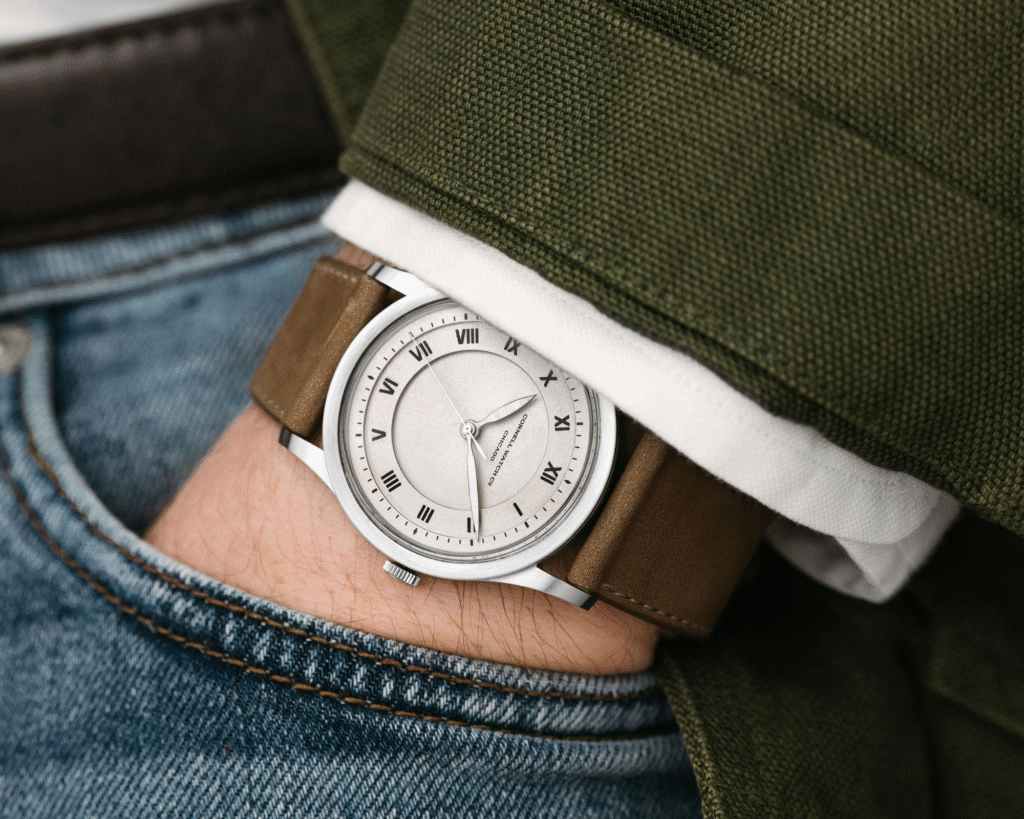
Whenever possible, Cornell made efforts to conduct both the design and production of the Lozier inside the United States. Technical design work was done by Alex Voss Design Studio in Santa Clara, California, while Hour Precision in Columbus, Ohio carried out the machining of the components, and assembly of the watches was performed by Justin Harrell and Sergio Berrios in Asheville, North Carolina. Meanwhile, the nubuck leather strap for the Cornell Lozier comes from Veblenist in Chicago, Illinois, and even steel used in the construction of the watch is supplied by Alro Steel in Jackson, Michigan. The three parts of the Lozier that do not come from America are its movement (made by Sellita in Switzerland), its crystal (supplied by Numata Kouki Co. Ltd in Japan), and the custom font for its Roman numeral hour markers, which was created by Samuel Baker in England.
As for the watch itself, the case of the Cornell Lozier is crafted from brushed stainless steel, and it measures 37.4mm in diameter by 8.5mm thick, which includes the additional height of the box-shaped sapphire crystal (with anti-reflective treatment on its interior surface) that slightly extends above the rim of its bezel. The lugs of the Lozier are set 22mm apart and extend to create an overall lug-to-lug profile of 46.8mm, with the proportions of its wide-set lugs creating a silhouette that is somewhat reminiscent of an early Patek Philippe Calatrava ref. 96 from the 1930s. The reverse side of the Lozier is furnished by a solid brushed stainless steel caseback that is entirely devoid of any markings, while its signed winding crown is laser-engraved with Cornell’s fleur-de-lys logo, and water resistance for the model comes in at 50 meters to protect against daily contact.
The dial is easily the standout feature on the Cornell Watch Co. Lozier, and it is machined from a solid block of German silver, with a three-layer stepped design that descends downward from the chapter ring towards the center. Each layer of the dial is separated by a thin diamond-cut bevel, and rather than being finished with some type of paint or coating, the surface of the dial showcases a frosted finish that highlights the natural warm hue of the German silver. The printed Roman numeral hour markers appear in a custom type called “Chicago Roman,” which was created by London-based typographer Samuel Baker and inspired by the Art Deco architecture that can be found throughout the city of Chicago. Meanwhile, the hands on the Lozier are also crafted from German silver, and they appear in a “Cornell Leaf” shape, with horizontally brushed surfaces framed by thin diamond-cut edges.
Powering the Cornell Watch Co. Lozier is the Sellita Caliber SW300-1 b automatic movement, which is the no-date version of the more common time-and-date Cal. SW300-1 (without the “b” at the end) that can be found inside a variety of different watches throughout the industry. Running at a frequency of 28,800vph (4 Hz) with a power reserve of 56 hours, the 25-jewel Sellita SW300-1 b offers a familiar and proven design, although Cornell uses the Elaboré grade version of this popular time-only movement, which means that it is adjusted in three positions and promises better timekeeping tolerances. Numerous different brands use movements based on the SW300 platform, but few take advantage of its rather svelte 3.6mm height, and the Cornell Lozier offers a surprisingly thin overall profile, especially for a self-winding watch.
One of Cornell’s goals when designing the Lozier was to create a model that could be more accessible to buyers, while still maintaining the brand’s mission to produce as much of the watch inside the United States as possible. With an official retail price of $6,200 USD, the Cornell Lozier costs nearly half of what it takes to secure an example of the brand’s original 1870 CE model, and this ultimately feels quite reasonable given its numerous American-made components. Deliveries of the Lozier are set to begin in the fourth quarter of 2025, with 50% of the price due upon placement of the order and 50% due prior to receipt. For someone like myself, who would love to own an American-made watch but will likely never be able to afford something from a brand like J.N. Shaprio, the Cornell Lozier represents an extremely compelling offering, and it’s impressive to see this level of U.S. manufacturing inside a watch that costs roughly the same as an entry-level model from one of the big-name Swiss brands. For more information, please visit the Cornell Watch Company website.